Bed bug eradication requires precise environmental controls adapted to local architectural types. In older structural framing found throughout Midtown, Central Gardens, and Cooper-Young, settling tongue-and-groove…
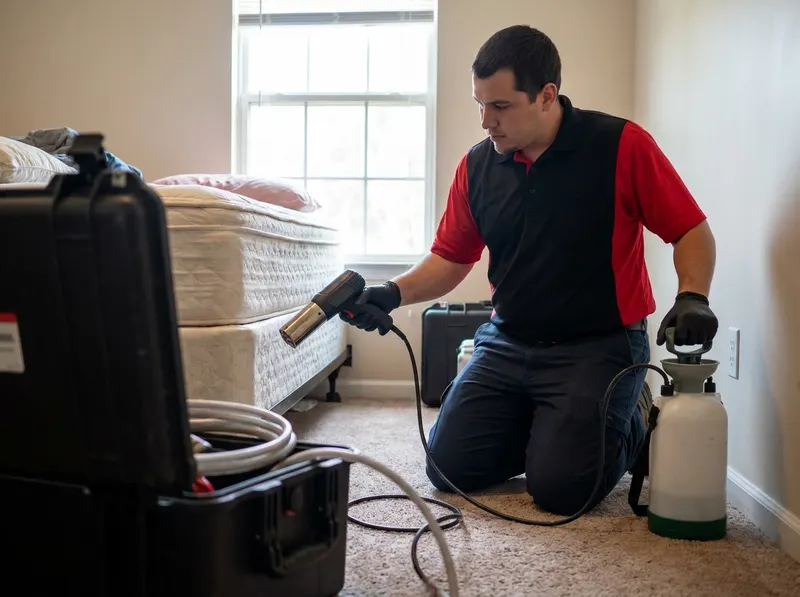
Bed bug eradication requires precise environmental controls adapted to local architectural types. In older structural framing found throughout Midtown, Central Gardens, and Cooper-Young, settling tongue-and-groove flooring and deep baseboard cavities allow Cimex lectularius to travel between wall studs undetected. Thermal eradication utilizes specialized high-output forced-air heaters monitored via digital thermistors, elevating ambient structural temperatures to an exact target between 125°F and 135°F. Research published through the Entomological Society of America confirms that bed bugs and their eggs experience complete cellular protein denaturation when exposed to sustained thermal levels of 122°F for at least 90 minutes. Structural heating bypasses chemical resistance profiles by forcing convective airflow into interior trim, behind electrical switch plates, and beneath subfloors where traditional spray applications cannot penetrate directly.
Properties located in High Point Terrace, Binghampton, and Berclair often feature concrete slab-on-grade construction or crawlspace foundations that react differently to thermodynamic shifts. Chemical eradication protocols utilize dual-action formulations evaluated by the U.S. Environmental Protection Agency, combining non-repellent insecticides with insect growth regulators (IGRs). These compounds disrupt juvenile molting cycles without causing dispersion. The Virginia Department of Agriculture and Consumer Services insect management research shows that pyrethroid-resistant strains fail to detoxify combinations containing synthetic desiccants like diatomaceous earth or amorphous silica gel. According to standards established by the National Pest Management Association, applying desiccant dusts within dry wall voids prevents lateral migration through plumbing chases shared by adjacent bedrooms or rental partitions.
The strategic trade-off between heat and chemical treatment hinges on structure density and budget considerations. Whole-structure thermal treatment costs significantly more due to heavy industrial power equipment and 6- to 8-hour dwell times, but it eliminates an active infestation in a single deployment with minimal occupant displacement. In contrast, residual chemical treatments maintain a lower initial entry price, beginning at the $250 minimum service base, yet require 2 to 3 separate applications over a 30-day window to intercept emerging nymphs. Guidance from the University of Tennessee Institute of Agriculture Extension underscores that effective eradication in humid Mid-South climates demands strict structural preparation. Homeowners must de-clutter perimeters, strip bed linens for high-temperature laundering at 140°F, and maintain interior relative humidity below 50% using indoor climate controls to accelerate product drying times.
Multi-family dwellings and single-family residences in East Memphis, Cordova, Whitehaven, and Hickory Hill require thorough perimeter monitoring following active treatment. Applying guidelines aligned with the Association of Structural Pest Control Regulatory Officials, technicians inspect adjoining rooms laterally, above, and below the primary infestation site. RedCedar Pest Solutions verifies eradication via active carbon dioxide traps and passive interceptor monitors placed under bed posts, compliant with industrial safety directives set by the Occupational Safety and Health Administration. Structural applications also follow water resource protections cataloged by the Tennessee Department of Environment and Conservation, ensuring zero runoff reaches residential storm drains.
Every job gets a firm, written price after a free on-site visit.
Tell us about your bed bug thermal & chemical eradication job in Memphis and we'll send a clear, written quote, usually the same day.
 RedCedar Pest Solutions